Accurate Subvoxel Location and Characterization of Edges in 3D Images Based on the Partial Volume Effect
1 Centro de Tecnologías de la Imagen (CTIM), Instituto Universitario de Cibernética, Empresas y Sociedad (IUCES), Universidad de Las Palmas de Gran Canaria (ULPGC), Campus Universitario de Tafira, 35017 Las Palmas, Spain
Abstract
The estimation of the position, orientation, principal curvatures and change in intensity of the edges in a 3D image with the highest possible accuracy provides extremely useful information for many image processing applications. Using the computation of the gradient vector in each voxel to estimate these features usually generates inaccurate results, even in noiseless synthetic images. This paper presents a new edge detector which is based on a model for edges and image acquisition. This model is derived from the Partial Volume Effect (PVE) concept and does not assume continuity in the image values. The proposed edge detector is able to cope with challenging situations, such as noisy images, blurred edges, low contrast, or nearby contours. First, the influence of the intensities of the voxels on their neighborhoods in first- and second-order edges is analyzed, with the purpose of demonstrating that such types of edges can be precisely characterized from the intensity distribution in the surrounding area. Afterward, this approach is extended to real scenarios, considering how adverse conditions can be tackled. The proposed technique has been tested on synthetic and real images, including extremely difficult edges, and achieving a highly accurate subvoxel characterization of the edges.
This work is an extension of the method described in [1]. For more detailed information about this technique see reference [2] quoted below. Please, cite such a reference in your research works if you use any of the results, data or software included here.
Experimental dataset and results
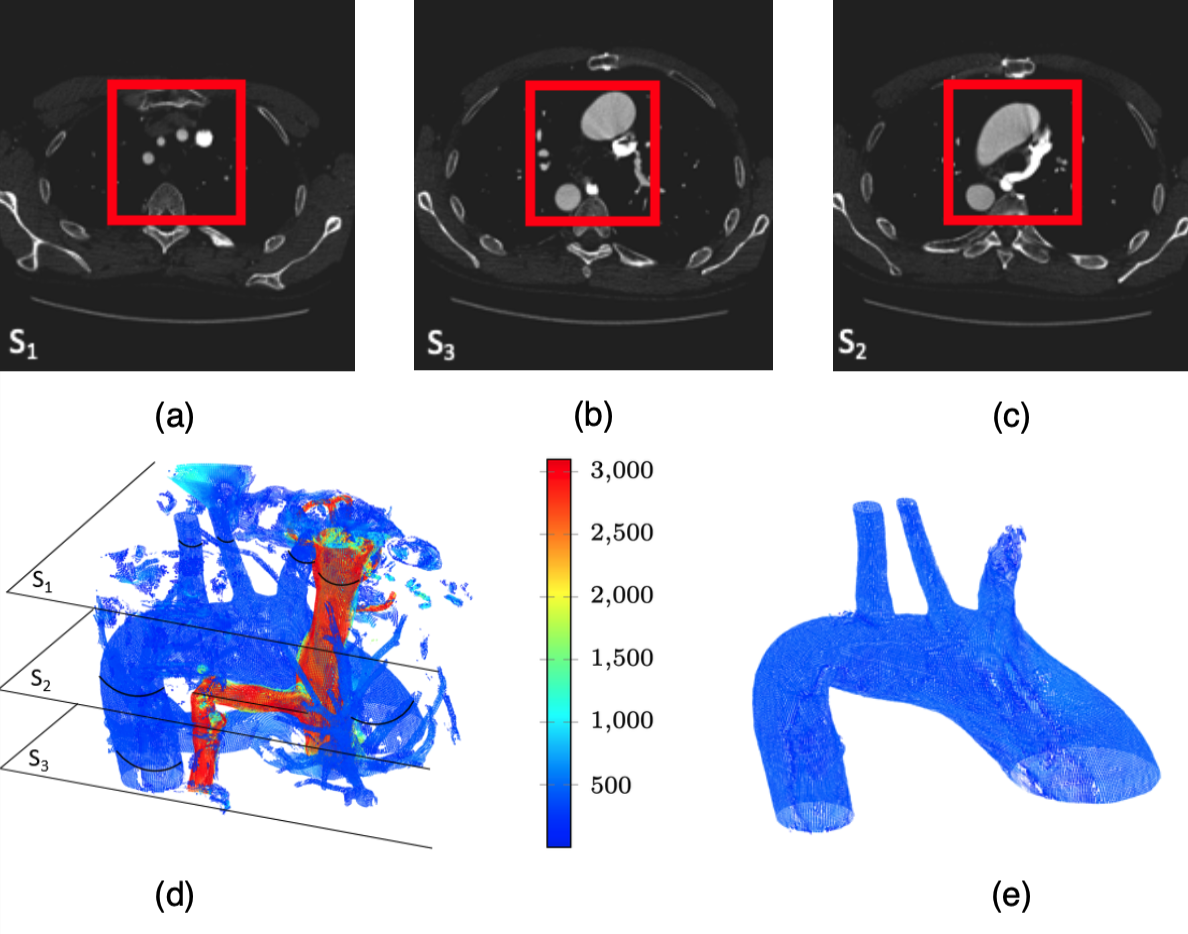
In the work described in [2], we perform experiments in a wide variety of synthetic images, with different features and noise levels, in order to assess the proposed technique. Moreover, we also present the results of applying the method on a synthetic phantom and a real angiography, both obtained with a CT scanner. For instance, in Figure 1, we show the outcome of applying the proposed technique to real CT angiography.
As described above, the dataset used in the experiments encompasses synthetic and real data. Regarding synthetic objects, you can generate them by using the scripts provided along with the code. On the other hand, we also include the scans in Analyze format. You can download them from the following link.
Software
An implementation in Matlab of the proposed technique is available at MathWorks. Along with the code, we also provide scripts to generate synthetic objects to test the method (they are parameterizable, for instance, the user can set the different radius for the sphere or torus). Moreover, two images are provided (in Analyze format): the scan of a synthetic phantom and a real CT scan (anonymized).
As an outcome, the detector provides an object of EdgeVoxel type. It contains several arrays with edges indexes, subvoxel positions, normal vectors, minimum and maximum curvatures, intensities at both sides, as well as voxel size.
Any comment or feedback is more than welcome. Please, email to Agustín Trujillo-Pino.Acknowledgments
This work was partially supported by Vicepresidencia Primera, Consejería de Vicepresidencia Primera y de Obras Públicas, Infraestructuras, Transporte y Movilidad from Cabildo de Gran Canaria, through the project of reference Resolution No. 45/2021.
| Developed by | Funded by |
|---|---|
 |
 |
References
- [1] Trujillo-Pino, A., Krissian, K., Alemán-Flores, M., and Santana-Cedrés, D.: Accurate subpixel edge location based on partial area effect. Image and Vision Computing 31(1): 72-90. 2013. https://doi.org/10.1016/j.imavis.2012.10.005
- [2] Trujillo-Pino, A., Alemán-Flores, M., Santana-Cedrés, D., and Monzón, N.: Accurate Subvoxel Location and Characterization of Edges in 3D Images Based on the Partial Volume Effect (submitted to Journal of Visual Communication and Image Representation) - Under Revision - Preprint.
Copyright
The software, results and data included in this page are distributed under the license: CC Creative Commons "Attribution-NonCommercial-ShareAlike" see http://creativecommons.org/licenses/by-nc-sa/3.0/es/deed.en